

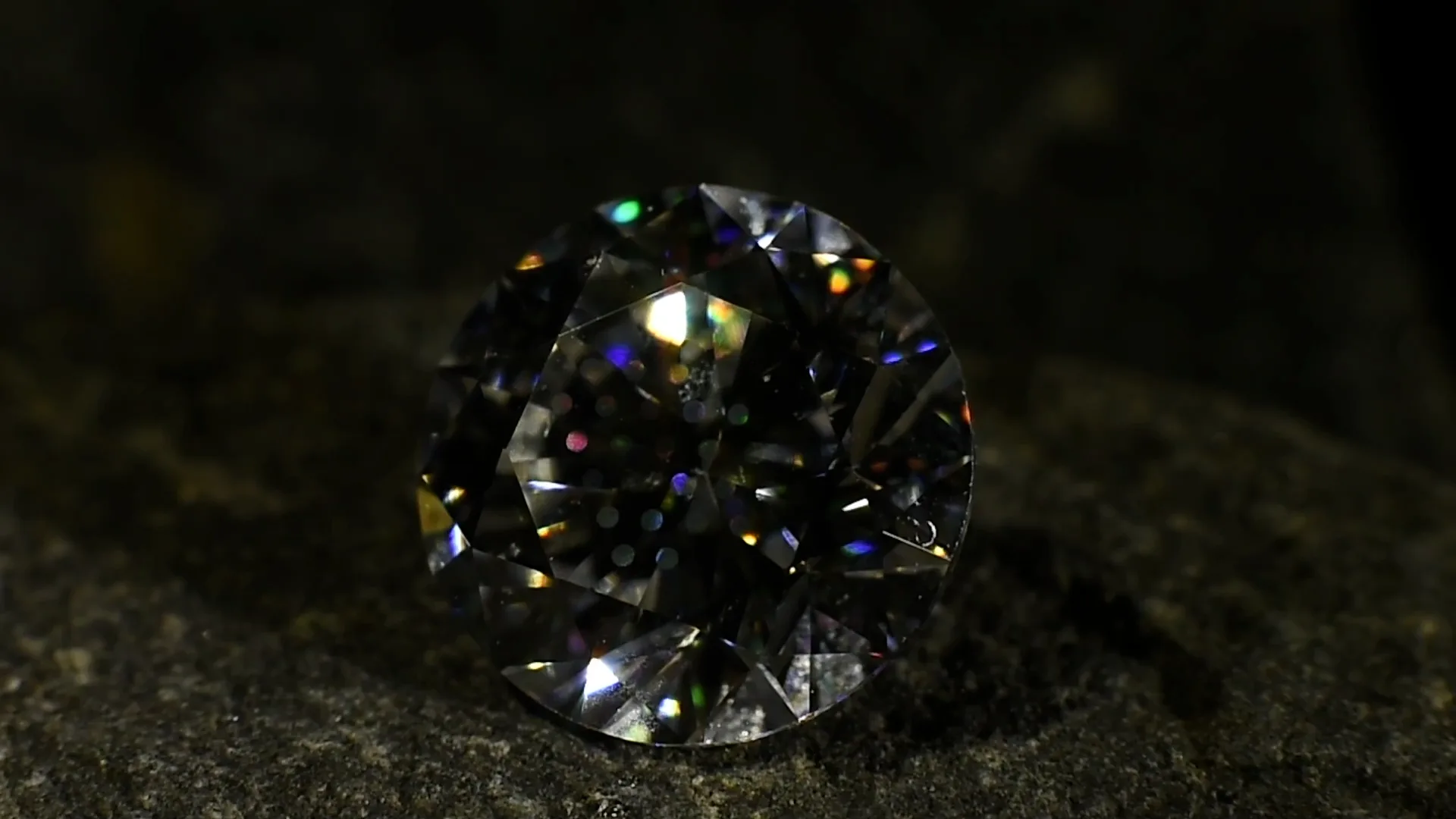
Laboratory-grown diamonds have fundamentally changed the economics of the diamond industry. As prices fall and availability rises, the central question for jewellers and brands is no longer about sourcing — it is about meaning. How do you maintain perceived value when the physical product has become a commodity?
Article Summary
- Lab-grown diamonds commoditised the stone. Price pressure alone cannot differentiate a jeweller or brand — the raw material is now identical regardless of who sells it.
- Personalisation moves value inside the stone. A permanent sub-surface mark creates a product that is inherently unique, regardless of who else sources the same raw diamond.
- Diamond ID makes this a B2B process — not a capital investment. No equipment to buy. Test on a lab-grown sample first. Add to your offer when ready.
This article is for you if:
- You sell or design jewellery and feel pricing pressure from online or chain retailers.
- You represent a brand looking for a defensible point of difference in the lab-grown segment.
- You want to understand how personalisation technology works at the material level — no engineering background needed.
Why lab-grown diamonds changed everything
Until recently, a diamond’s story was simple: mined from the earth, certified, sold. The certificate was the proof; the rarity was the value. That model worked because diamonds were genuinely scarce — and that scarcity was credible.
Laboratory-grown diamonds broke that logic. Chemically and physically identical to mined stones, they introduced something the traditional market never had to account for: abundance. By 2024, lab-grown diamonds had captured nearly 20% of the global diamond jewellery market by volume¹, and prices continued to fall as production scaled.
For the consumer, this is welcome news. For businesses selling diamonds, it raises a harder question: if the stone itself is no longer rare, what justifies a premium price? And if the answer is “the brand” or “the craftsmanship” — how does any of that become visible inside the stone itself?
¹ Edahn Golan Diamond Research & Data, 2024 annual report. Data refers to units sold, not value.

What personalisation adds to a stone
A laser mark inside a diamond is not decoration. It is information — permanent, unalterable, and unique. Unlike a surface engraving on a ring band, a sub-surface inscription cannot be removed without destroying the stone itself.
This changes what a stone can carry. A diamond can now hold a name, a date, a handwritten signature, a family crest — made visible with a loupe or under particular light. The stone stops being a commodity and becomes a vessel for meaning.

“The stone stops being a commodity. It becomes a vessel for meaning — specific to one person, one moment, one relationship.”
— Dr. M. Kołda, Diamond ID technology brief
² The inscription uses a femtosecond laser at 10⁻¹⁵ s pulse duration, creating structural changes inside the diamond lattice without surface contact. Nanores internal research documentation, 2023.
How the technology works — without a microscope
The process uses a focused ion beam (FIB) to create a controlled structural change within the diamond’s carbon lattice. Unlike surface-level laser engraving, the modification occurs below the surface — inside the stone, at the nanometre scale. The result is a mark that is permanently part of the diamond’s structure.
For the end consumer, this is visible with a standard 10× loupe — the kind any jeweller carries. No special equipment, no smartphone, no additional reading device. The inscription is there, readable, durable, and identical to the diamond itself in permanence.
Curious what a personalised stone looks like in practice?
Request a sample
What this means for jewellers and brands
The commodity pressure on diamonds is not going away. The question for jewellers and brands is not whether to adapt, but what form that adaptation takes. Price competition is a race with no sustainable finish line — and increasingly, it is a race being run against entities with far greater scale and distribution than any boutique workshop.
Personalisation offers a different answer. Not “we sell better diamonds” — but “we create something that cannot be replicated, compared, or found anywhere else.” That shift changes what the customer is buying: not a commodity, but a unique physical object with a specific meaning. And that difference lives inside the stone — not on a certificate, not in a shopping bag.
Traditional market approach vs. Diamond ID
| Criterion | Traditional approach | Diamond ID approach |
|---|---|---|
| Stone identity | Anonymous — any retailer can source the same stone | Unique — inscription is inside the stone, non-transferable |
| Comparison basis | Price, certificate, visual grade | Story, meaning, origin — physically embedded |
| Perceived rarity | Dependent on mining certification | Inherent — the inscription creates uniqueness |
| Brand protection | External — packaging and branding | Internal — the stone carries the brand signature |
| After-sale connection | Weak — stone untraceable after sale | Strong — identification persists for the stone’s lifetime |
| Price negotiation | High — direct comparison with competitors | Low — no equivalent product to compare against |
| Setup (B2B) | None — sell existing inventory | Sample test + onboarding (weeks, not months) |
Case study
[Partner name] — A boutique jeweller’s first 60 days with Diamond ID
When [Name] first tested Diamond ID on a lab-grown brilliant intended for a commission piece, the client’s reaction changed the conversation immediately. To be replaced with a real partner case study when available.
[Insert real case study — partner name + measurable outcome]